Showing posts with label Watershed Hydrology. Show all posts

Monday, July 15, 2013

SRAP Student Spotlight: Antonio, Water Issues and Mathematics


SRAPer: Antonio Duran

Home State: Colorado

Year on School: Junior

Plans after high school: Attend college and major in architectural engineering

 
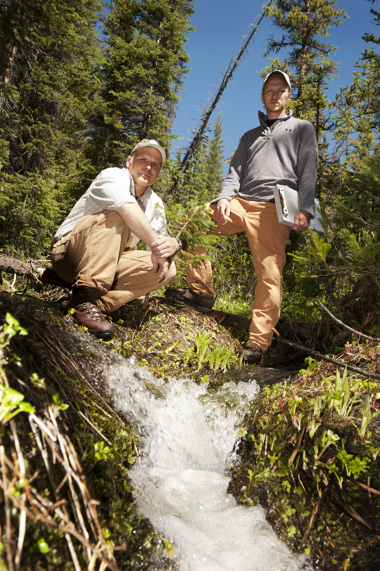
Jagath (left) and Antonio working on field notes

Unlike many of his high school peers, Antonio’s favorite subject is math. Studying water is not exactly what he had in m

ind when he enrolled in SRAP, but his interests in math are being applied to water in a way he never anticipated.

“We are going to put small dams in streams near Laramie in order to better calculate discharge for the summer months,” Antonio says.

Antonio is in charge of building this dam, called a weir.

“The goal is to learn how to engineer weirs,” Antonio says. “I’m interested in engineering. The most interesting part of the project is the designing process and getting to talk to everybody.”

Antonio taking measurements in a stream
Antonio’s project is part of the bigger WyCEHG project. Along with his mentor, Dr. Scott Miller, Antonio has had the opportunity to work with several WyCEHG researchers in and out of the field. In the early stages of the project, he helped take flow measurements with WyCEHG PhD student Jagath Vithanage, researched weir structure and created engineering designs to be built by the manufacturing lab in the College of Engineering and Applied Science.

“The weirs will help us better understand the characteristics of flows in small streams in Wyoming,” says Dr. Miller. “We have been studying these streams for a few years and have been limited in our ability to characterize stream flow in the summer because of our instrumentation. I am extremely pleased with both how well Antonio has done on his project and the fact that his weirs will be of benefit to many scientists today and in the future.”

After his weir designs were built, Antonio and Jagath installed them in several of the creeks around Pole Mountain between Laramie and Cheyenne.

“Antonio’s designs were spot-on,” says Jagath. “He took charge of the specifications, calculated the dimensions, and worked with the engineering shop to make sure the weirs were constructed properly.” 

With the weirs in place, the next stage in the project is to really put Antonio’s math skills to use. The data from automated samplers will be transformed into discharge measurements using the weir equations Antonio developed.

“Antonio is going use his interest and skill in mathematics to help us calculate streamflow automatically from devices we leave in the field,” says Dr. Miller. “This way we can know what is happening around the clock and better understand the system. Anotnio’s participation in the research has been a huge help.”

While the connection between math and water wasn’t immediately clear at the start of his project, it has given Antonio a great experience with applying math to real-world problems.

“I think SRAP is a really great program and it is a great experience to be here,” says Antonio. “It’s nice to see how it is to really research and how life is in college.”

SRAP is a six-week long intensive research program based at the University of Wyoming and sponsored by Wyoming EPSCoR.

By Kali S. McCrackin
Photos by Robin E. Rassmussen and Kali S. McCrackin

Wednesday, July 10, 2013

SRAP Student Spotlight: Griffin and Mapping Regional Isotopes

SRAPer: Griffin Gilmore
Home State: California
Grade in School: Senior
Plans after high school: Attend Air force Academy, if possible, and major in either astrophysics or astronomy


Griffin takes down field notes
Energy and curiosity are key ingredients when it comes to being a scientist and Griffin Gilmore has plenty of both. While the planning stages of a project often lack the excitement of the implementation stage, Griffin is enthusiastic about all aspect of his project, planning included. He knows exactly what he wants to accomplish and how to reach that goal.

“My SRAP project is about taking samples of isotopes from the Laramie River and Crow Creek watershed,” Griffin explains. “Then, from those samples, we can make an isoscape, which is a map of the isotopes within a region so that we better understand how water flows throughout the area.”

This project is part of the larger WyCEHG project, focused on understanding Wyoming water systems. Griffin’s work will contribute to the knowledge WyCEHG is working towards and plays an important role in understanding the relationship between ground water, sub-surface water and precipitation.

Griffin is working with Dr. Scott Miller, a spatial processes hydrologist at the University of Wyoming and co-principal investigator for WyCEHG. Dr. Miller is enthusiastic about the project, because it is centered on a new way of approaching water science.

“Griffin is working on an emerging kind of water science at UW,” says Dr. Miller. “His research is the first attempt at using isotopes to understand how water changes downriver in these systems. Griffin has come up with a very clever project and his research will be beneficial to the WyCEHG project. It’s terrific to have a high school student contribute to fundamental science.”

While Griffin is still getting everything ready and preparing for several days of field work, he is most looking forward to the analysis process in the Stable Isotope Lab.
Griffin takes a measurement at one WyCEHG site
“I’m really going to enjoy the in-lab work,” Griffin says. “I like anything about chemistry, isotopes included.”

In addition to chemistry, Griffin likes physics and astronomy.

“Ever since a young age I’ve been fascinated with astronomy and there’s a lot of physics within astronomy,” Griffin says.

Griffin’s love of astronomy and physics is what makes the Air force Academy appealing with its strong astrophysics program. No matter where he decides to go for college, however, Griffin is ready for starting a career in science.

“I think SRAP is a great opportunity,” Griffin says. “It’s great for college and great for getting experience in the science fields.”
 
SRAP is a six-week intensive research program based at the University of Wyoming and sponsored by Wyoming EPSCoR.
By  Kali S. McCrackin
Photos by Robin E. Rasmussen and Kali S. McCrackin
 

Wednesday, June 12, 2013

New Field Course Begins for Wyoming and Mississippi Students

When it comes to the natural environment, Wyoming and Mississippi do not have a lot in common. The arid plains and mountains of Wyoming contrast drastically with the humid plains of central Mississippi. The differences, however, offer ample opportunity for an expansion of knowledge. Tomorrow, students from both states will join together to begin a two week field research course focused on hydrology, ecology and geophysics.
This field course is the beginning of a collaboration between Jackson State University (JSU) and the University of Wyoming (UW) through the Wyoming Center for Environmental Hydrology and Geophysics (WyCEHG). The goal is to offer students from both institutions a chance for exposure to new environments while increasing knowledge of field techniques and equipment use. Dr. Scott Miller, one of the principal investigators for WyCEHG and a lead for the camp, believes that such a collaboration offers important new opportunities for everyone involved.
“The collaboration is compelling for several reasons,” says Dr. Miller. “For one, the geologic and hydrologic settings of the southeastern United States and the Rocky Mountains provide an excellent contrast for field studies and environmental interpretation. Second, students from both institutions will gain familiarity and exposure to very different physical and cultural geographies. Third, faculty and students at JSU and Wyoming have shared research interests, and this field course will provide a mechanism for academic exchange. Students will be trained on various critical techniques, including field observation and use of hydrogeophysical equipment that will prepare them for both the job market and academic research.”
Faculty from UW that will be teaching parts of the course include Dr. Miller, from ecosystem science and management; Dr. Steve Holbrook,from geology and geophysics; from Dr. Dave Williams, from ecosystem science and management and the director of the Stable Isotope Facility; Dr. Brent Ewers, from the botany department; and Dr. Brad Carr, manager of the Facility for Imaging the Near and Sub-surface Environment.  Together, the team will create a dynamic, interdisciplinary research experience.
More information about the field course and the JSU-UW collaboration can be found at: http://www.uwyo.edu/uw/news/2013/05/jackson-state-university-contingent-to-study-hydrology-at-uw-this-summer.html

 By Kali S. McCrackin

Monday, March 4, 2013

Investigating natural relationships: Tracing water pathways in the Snowy Range Mountain


Wil Chapple with the distillation system at UW
Challenging traditional thought is part of what science is all about. For one EPSCoR undergraduate fellow, challenging historical assumptions about the natural water system is the focal point of his research.
 “We’re trying to understand plant-water relationships and determine if the water that trees are consuming is also the water that contributes to stream flow,” says Wil Chapple, one of the first undergraduate researchers for WyCEHG.
Wil started at the University of Wyoming as a history major, but today he is studying the history of glacial events in order to better understand the water system in the Snowy Range Mountains. There were three glacial events which shaped the types of soil in the Snowies. Wil believes that these different types of soil are part of the key to understanding the water system. His motive for studying the water system comes from a discrepancy between traditional thought and recent discoveries.
“There’s a traditional thought that current precipitation mixes with old precipitation and that trees consume this and that it is part of the stream flow,” says Wil.
Recent research from another university indicates that this may not be the reality. This research shows that plants may consume water stored in soil pores from past precipitation while new precipitation goes to stream flow.
“So, some of the water that comes in as precipitation might fill up that small pores in the dry soil earlier in the season and sit there, and later snow melt events might just rush right past the trees,” says Dr. Dave Williams, Wil’s mentor for the project. “During the summer, when the plants are taking up water, they might be slowly drawing on that water from soil pores and not from the snow melt.”
In order to study this phenomenon in the Snowies, Wil is collecting samples of snow to analyze the isotope signature of the precipitation.
One of Wil's research sites
“We’re using isotopes to trace water and how that water partitions differently depending on the history of the glacial events that created the soil,” says Dr. Williams. “If the soils have no effect on the way the water moves, then water that the trees are taking up and their isotope signature is going to be the same as what the signature is downstream.”
Isotopes are useful tracers because the origin, type and temperature of precipitation determines the isotope composition, thus precipitation events have different isotope configurations. The configuration of isotopes follow some patterns in that heavy water molecules characterize summer and fall precipitation compared to that of the winter and spring. The isotope composition of a compartment of water is determined by the ratio of heavy to normal atoms, which Wil will be analyzing to determine isotope signatures.
Wil will determine the isotope ratios using the Laser Spectroscopy Isotope Analyzer in the Stable Isotope Facility at UW. This equipment vaporizes water samples and measures the absorption of different wave lengths of light. Different isotopes absorb different light frequencies. By going back and forth between frequencies, it is possible to determine the ratio of heavy to normal isotopes in the water. Wil is preparing to analyze snow samples from the last few months, which have been collected every morning there is new snowfall.
As his research continues, Wil is also busy working on the proposal for this next stage of his project. This summer he aims to collect and analyze samples of soil, water from streams and lodgepole pine. With the deadline for the summer fellowship one week away, Wil is focused on showing what he has learned and where he wants to take his work.  
“It’s been a good experience so far,” says Wil. “I feel like I’ve only kind of dipped my toes in and hopefully this summer I will really get a taste of this research and field work.”
This project has given Wil a glimpse into the life of a water scientist and helped him get a feel for what graduate school might be like, but it has also allowed him to go beyond the theoretical knowledge of the classroom and into the application of science.
A second research site
“It feels good to apply my knowledge,” says Wil. “Last semester I felt like I really came out with a lot of tangible knowledge and it was refreshing.”
Part of this knowledge came from Dr. Larry Munn, who, as Wil says, is the soil guru of UW. Dr. Munn has spent most of his life studying and developing the knowledge about the distribution of soils from the different glacial events in the Snowies. His research has been instrumental in Wil’s understanding of the Snowies.
“We’re quite fortunate that Wil has been able to work with Larry,” Dr. Williams says.
As is the goal of all WyCEHG research, Wil’s project is a collaborative process. It brings together knowledge from various fields and experts, looks at the complexities of the natural water system and aims to shed light on how historical events shape the present.
“I think this project is really cool because it brings forth this long history of glacial events and how that’s shaping how water moves in the landscape,” says Dr. Williams.
Wil’s research will shed light on the water movement and add to the body of research challenging traditional assumptions about water systems.

Thursday, February 21, 2013

Measurements and Modeling: A Look into the Hydrologic side of Wyoming


In the next few months, you might notice a flurry of activity and an influx of equipment in the Snowy Range, especially if you aren’t one for sticking to the trails. If you stumble upon a stream with an equipment draped tower nearby, you may have found one of the watershed research sites for the Wyoming Center for Environmental Hydrology and Geophysics (WyCEHG). Though it may look like a jumble of metal and plastic, each piece of equipment is busy acquiring important data about water to help teams of researchers at the University of Wyoming better understand water in Wyoming and the West.


A water sampler
WyCEHG was established by a five-year National Science Foundation grant with the goal of providing water resource managers, stakeholders, and scientists with cutting-edge knowledge and tools to improve water management. As the headwater state for many of its neighbors, Wyoming has to ensure that water allocations are met and that Wyoming communities still have enough water. To do this, it is essential to have a complete picture of the natural water system, which is currently not well understood. WyCEHG brings together researchers from a multitude of fields to help create this complete picture along with two support facilities: the Facility for Imaging the Near and Subsurface Environment (FINSE) and the Surface and Subsurface Hydrology Lab (SSHL). This week we’ll look at SSHL and the hydrological side of WyCEHG.

“SSHL is not just a location where equipment is stored,” says Elizabeth Traver, the faculty manager of SSHL. “It’s kind of a research and training umbrella to help people figure out what instruments they need and get them out in the field.”


A tipping bucket
Since her start at UW in December, 2012, Traver has been busy helping researchers prepare for their field work. “I’m facilitating researchers, whether they’re undergraduate students or professors, with their research and equipment,” she says. “People are telling me what they need and I’m purchasing those items so that they’ll be here when they need them.”

While the bulk of WyCEHG research will happen during the summer months, some projects are already underway. In addition to on-going field projects centered on meteorological observations linked to tree respiration, soil water and the transport of water though our mountain systems and into streams, two emerging projects focus on snow. Snow is an essential part of the hydrologic picture in Wyoming where most river and ground water comes from snowmelt. One project looks at how much water is actually coming from snow by using a snow equivalency instrument.

                “Snow can have a little or a lot of moisture in it: light, fluffy snow compared to wet, heavy snow,” says Traver. “So what a snow water equivalency instrument does is it actually tells you how much water is in the snow that fell, because the water itself is what is important and not how deep the snow is.”

The other project is about snow isotopes, or the variants of chemical elements in the snow.


“You can take the isotopes in the snow and determine the possible origin of that snow based on the isotope relationships,” Traver says.

By developing a library of isotopes in rainfall, snow, groundwater and streams, the WyCEHG team will gain a better understanding of the ultimate fate of our rain and snow and address the critical questions: does it end up back in the air through evaporation, down in the ground or glowing through our rivers?

A map of the watershed in the Snowy Range Mountains
An undergraduate student has begun to collect snow samples from around the Snow Range Ski area, which he will study using isotope analyzers. While the bulk of winter research is centered on snow sampling, researchers are also preparing for the spring thaw. The area of focus for the summer is a small unnamed creek that drains into Libby Creek, which flows into the Little Laramie River downstream from Laramie.

“There are things that we want set up before the snow starts to melt because we want to be ready for the most important time of the year, water-wise,” says Traver. “We will be putting a whole bunch of instruments on the tower with the ones already out there. We’re just trying to get as much detail as we can from that one specific area.”

The ultimate goal of studying this one watershed in so much detail is to create a water model that can be used in other watersheds.

“The idea is, measure everything, put these parameters in the model and figure out which processes are most important,” Traver says. “Then we can go to a different watershed, measure just those parameters and see if our models will work.”

This type of approach, linking measurements and models, will ultimately help water resource managers, stakeholders and scientists understand what happens to every drop of water in the watershed. This knowledge will help empower them to make scientifically founded decisions about water use and allocation.
 
By Kali S. McCrackin
Photos courtesy of WyCEHG

Friday, October 19, 2012

World experience and work in Wyoming: The global importance of watershed management

This story is the second of several stories featuring EPSCoR personnel and their roles in merging science, education, research and outreach. Dr. Scott Miller is a principal-investigator on one of two EPSCoR grants. This story focuses on that grant and Dr. Miller's work.

Dr. Scott Miller and one of his graduate students.
Dr. Scott Miller was thirteen years old when he first experienced the consequences of poor land management. His parents sent him to Nepal on a backpacking trip, and one day he came across a village that had just been devastated by a landslide. It was monsoon season and the slope failure was due to deforestation. The village had been chopping down the forest to free the land for agricultural use.
“It was very striking to see the connection between forest management and severe consequences to people, including loss of life,” Dr. Miller says.
Dr. Miller’s experience in Nepal urged him to pursue an undergraduate degree in geological sciences. A few years after college he returned to Nepal to work on a dam project, but quickly realized that he needed more technical training, which led him to the field of watershed management. Today, Dr. Miller is a watershed hydrologist at the University of Wyoming.
“The fascinating thing about hydrology and water management is that we are always in a state of flux,” Dr. Miller says. “And, humans are intimately connected to water.”
The connection between humans and water is one of the major driving forces behind the $20 million EPSCoR WyCEHG (Wyoming Center for Environmental Hydrology and Geophysics) grant, on which Dr. Miller is a co-Principal Investigator with Dr. Steve Holbrook.
“What happens in Wyoming affects a huge number of people that are outside of Wyoming,” Dr. Miller says.
Wyoming is the headwater state for many western states. Good water management is absolutely essential because so many people and such a large ecosystem downstream depend on it. Understanding water in Wyoming is also important because there is a high degree of variability in the climate which dictates how and where water comes from.
“From a hydrological perspective, it is really quite fascinating to work in Wyoming,” Dr. Miller says. “The vast majority of our moisture that drives water in rivers and streams occurs at very high elevations. All of our downstream rivers are dependent on what happens up in the mountains. So, it is a really interesting place to work because of the significant changes in climate and hydrology as you travel from the plains up to the headwaters.”
So far, all of the research sites for the WyCEHG grant are located in mountains throughout the state. This setting is an ideal place for someone like Dr. Miller to conduct research because it is constantly challenging.
“I like being surprised by observations in the field or outcomes from models that I didn’t expect,” Dr. Miller says. “It is very stimulating to tackle something that is not really well understood.”
The water system in Wyoming is one area that fits this description, especially in terms of in-depth understanding because of the high variability. As a Watershed Hydrologist, Dr. Miller will be using his expertise to look at how water is moving through the geologic systems of the mountains and how altering surface processes change water movement.
“There are a variety of disciplinary ways to tackle water,” Dr. Miller says. “In my field usually what we do is go out and put instruments in rivers, measure the flow of water through rivers at various places, look at how much rainfall or snow is coming in, understand the meteorological signals and then measure things like soil moisture and ground water depth. Even with this approach we are still left with an incomplete picture of how water moves through a system because of the heterogeneity of the subsurface.”
To create a more complete picture of hydrological systems, watershed hydrologists build models which represent the actual processes occurring in nature. These models give scientists a spatial perspective of water movement, but they too are incomplete. The best way to create a complete picture is through interdisciplinary work across fields. Watershed hydrology, geophysics, plant ecology and various other fields contribute important information to water research.
“I feel, and this is the purpose of the grant, that by integrating all these different disciplines we will do a better job of getting a fuller portrait of how hydrological systems work,” Dr. Miller says. “The opportunity to have a significant impact is greater when you work in a team. It’s worth the effort to overcome the barriers to interdisciplinary work.”
The importance of interdisciplinary collaboration is an experience Dr. Miller learned and took to heart during a project in Kenya. The project was based on interaction between scientists and stakeholders, and relied on positive collaboration in order to benefit the community in which they were working.
“The place I evolved most rapidly as a scientist was when I was working in Kenya because of the cultural challenges, the positive outcomes of working across cultures and the high relevance of the research,” Dr. Miller says. “I advanced a lot, both as a scientist and as a human being.”
The research funding in Kenya was directed towards impacting people’s lives and livelihoods, which forced the scientists to focus on the most relevant aspects of water in order to help the local people. This emphasis on relevancy is mirrored in the WyCEHG grant, which will help inform water managers in order to help the people dependent on Wyoming’s water.
“We will hopefully be able to provide a better scientific framework for understanding what to expect in the next several years regarding water, which will allow for more appropriate planning,” Dr. Miller says. “If we can improve scientific understanding, we can improve decisions.”

By Kali McCrackin
Photo courtesy of the University of Wyoming