This is a blog about Wyoming EPSCoR, the projects we do and the grants we are working on. From student internship programs, to grant work, to research, we're sharing our news and stories for our community to read and share. Thank you for visiting our site!
Friday, May 3, 2013
Wyoming Water Week
Water Week is May 6th-May 11th. Information about viewing these programs can be found at: http://www.wyoptv.org/programming/schedules/.
For more information about Glen Canyon: A Dam, Water and the West, as well as a collection of historical images tracing the life of the dam, please visit: http://www.kued.org/productions/glencanyon/about/program.html
Water: The Lifeblood of Energy describes the connection between water and energy, as well as efforts to create a balance between the two. More information can be found at: http://www.prairiepublic.org/television/prairie-public-on-demand/water-the-lifeblood-of-energy
Safe water is a scarcity in many parts of the world, including the United States. Seeking Water from the Sun looks are water scarcity in the United States and at how solar energy may help make clean water. More information about the film is available at https://originals.azpm.org/seekingwater/
We hope you can join us in watching these films.
Wednesday, April 24, 2013
Dawn Allenbach at UW April 25-26
On Thursday, April 25 and Friday,
April 26, Dawn Allenbach, a Ph.D. candidate at the University of New Orleans,
will visit the University of Wyoming to share her experience as a scientist and
to talk about her research. This week on the blog, we would like to share her
biography and encourage you to attend her presentations.
Dawn M. Allenbach, MS
Ph.D. candidate in Conservation Biology
Dawn M. Allenbach was born with a neuromuscular disease called spinal muscular atrophy (SMA). SMA is a genetic recessive disorder that prevents skeletal nerves from transmitting signals to skeletal muscles, causing them to progressively atrophy over time. She first showed signs of the disease at around 18 months of age but was not definitively diagnosed until the age of three years. Doctors immediately advised that Dawn and her sister Stacy (one year of age, also diagnosed with SMA) be placed in an institution because of the great amount of physical care they would require over their life span, which the doctors said would not exceed 20 years. Fortunately, her parents didn’t listen. They chose to raise all three of their children (including little brother Paul, six years Dawn’s junior, who was also diagnosed at one year of age) in the same manner as they would a child without the disease.
Dawn’s father told her and her siblings early in their
lives, “You WILL go to college. End of
discussion.” To that effect, Dawn
graduated high school as a member of the National Honor Society (NHS) in 1989,
from Hutchinson Community College (AA in biology) as a member of Phi Theta
Kappa NHS in 1991, and from Wichita State University (BS in biological
sciences) as a member of Golden Key NHS and Mortar Board NHS in 1994. She went on to earn her MS in biological
sciences, emphasis in ecology and environmental toxicology, from WSU in 1997.
Dawn is proud to say she graduated with a mere $1000.00 of debt, thanks to the
grants and academic scholarships that paid for her undergraduate degree and a
teaching assistanceship she held during her graduate degree. Dawn is currently a Ph.D. candidate in the
conservation biology program at the University of New Orleans and plans to
defend her dissertation this summer. During
her studies at UNO, she received the Louisiana State Board of Regents Superior
Graduate Fellowship and the Ford Foundation Dissertation Fellowship. Both her masters and Ph.D. work have examined
the effects of pesticide runoff on fish.
In the future, she hopes to also examine the full life cycle effects of
residual nanoparticles on fish.
Much hated in her life is the fact that Dawn has outlived
both her siblings. Stacy died in 2001 at
the age of 27. She was four months short
of achieving her elementary education degree from Western Illinois University;
however, the university did posthumously grant her
degree. Paul died in 2007 at the age of
30. He was six months short of receiving
his master of arts in English literature from Wichita State University; again,
his degree was posthumously granted, and his parents were invited to a special
awarding of his diploma during graduation.
Dawn has determined to be fully, corporeally present for her hooding
ceremony in honor of her two first and best friends.
Please join us Thursday,
April 25 at 11a.m. in the Union Family
room (212) for Dawn’s presentation of Dairy of a Gimpy Kid: The Adventures of a
Would-be Biologist, and on Friday, April 26 at 12:10 p.m. in room 138 of the Berry
Center for Effects of Climate Change and Land Use-Related Stressors on Medaka
(Oryzias latipes).
By Dawn Allenbach
Thursday, April 18, 2013
Words, pictures and adventures: Wyoming EPSCoR's Communications Coordinator
Earlier this year we started a series of blogs about the EPSCoR office. The following is part five of the series and focuses on Communications Coordinator, Kali McCrackin.
Our staff member, who quietly interviews, creatively writes
and photographs, promotes and advertises and effectively communicates to a
large and very diverse audience needs to be recognized herself! EPSCoR’s Communication Coordinator, Kali
McCrackin, leads a full and inspiring life definitely worth sharing.
| Kali at the Grand Canyon over spring break in March. |
Kali grew up in Laramie and is a graduate of Laramie High
School. To provide an idea of the
motivated and go-getter attitude that Kali possess: After her freshman year at the University of
Wyoming, Kali went to Tanzania, Africa to teach English. Imagine, an 18-year-old woman leaving her
family, friends and the life that she knows and traveling alone to Tanzania
for a month.
“Going to Tanzania is one of my proudest accomplishments,”
Kali shares. “Travelling abroad, and to
Africa specifically, was something that I always wanted to do. I feel like it is where I grew up and it was
a life-changing experience for me. It is
also where I met my boyfriend, Andy.
Tanzania will always be a very special place for me.”
Currently, Kali is a senior graduating in May. She is majoring in journalism and
international studies and minoring in creative writing and French. Additionally, she is in the Honors Program at
the University of Wyoming, where she met her now closest friends during her
very first semester. Kali has studied
French since she was in the seventh grade and also went abroad to Tours, France
in 2011 during her junior year. While in
France, she studied at the François Rabelais University. She has also completed an independent study
project on Africa.
Kali also works part-time for EPSCoR and the College of
Engineering. As the Communications
Coordinator for EPSCoR, she accesses all multi-media forums, including
Facebook, Twitter, blogs, newsletters and video. And, she does this with a large team of
scientists, researchers and educators often joining – with camera, notebook and
recorder - these folks in the field. “I
love working with EPSCoR. I am so happy
to apply my degrees and have the opportunity to write and meet people. No day is ever the same, which is so unlike
other jobs.”
Where does the creative writing come in? “I got into writing through stories. My mom always read to us [my brother and I]. I learned to write through reading. I did a lot of creative writing in high
school, including novels, which I now need to take the time to edit.” Kali continues, “At the University, I mainly
write short stories.”
Reading and writing hasn’t always been easy for Kali. “I was a poor student in elementary school. I didn’t learn to read until I was eleven and
in the fifth grade. My teacher worked really
closely with me.” Overcoming this
challenge rooted Kali’s attitude, “I learned early-on that if I worked hard, I
can do anything.”
Kali has proven that she can do anything. Kali is one of twenty Arts and Sciences
Outstanding Undergraduates and a nomination for the Spitaleri Award - the best
female undergraduate award. For this
award, Kali was interviewed by a panel of twelve faculty and administration
members from all over campus. (The
Spitaleri award will be named on April 26th.) She is also a member of the Phi Beta Kappa
Honorary Society and the International Studies Honorary Society.
If not exhausted already just reading about Kali and her
accomplishments, Kali is completing her Honors Program project about literature
and photography. This project is a
combination of the history of the two working together and a series of four
(yes, four) short stories (written by Kali) with pictures (taken by Kali). The last story is told almost completely through
photographs. Kali will present this
project on April 26th at the Undergraduate Research Day and the end
of June at a presentation conference in Steamboat Springs.
In addition her scholastic and academic interests and accomplishments,
Kali also likes to be outside running, hiking and road biking. She was on the ski team in high school and
still enjoys skiing.
“I have to be busy,” Kali admits. “I don’t know what relaxation is. I thrive with a lot to do. My mom is the same way and I think I learned
this from her.”
Following graduation in May, Kali will spend the summer in
Laramie. She then plans to travel to
Asia in August to teach English for at least a year. “If I really love it, I will stay
longer. This is what I’ve looked forward
to doing: travelling abroad after
graduation. Maybe go back to
Tanzania. I want to travel and explore
and experience before finding a real job.”
Surely, these travel adventures will enhance Kali’s already
diverse and broad experiences. She hopes
to someday find a job similar to what she currently does, “A multi-media
communication position with an organization that I believe in. I want to be able to creatively get the
information out!”
By Beth Cable
Photo courtesy of Peggy McCrackin
By Beth Cable
Photo courtesy of Peggy McCrackin
Friday, April 12, 2013
FINSE: Keeper of the Geophysics Equipment
Snow, snow and more snow. That’s the weather forecast for the next week, much to the disappointment of Laramie’s inhabitants. While we are ready for the warm spring weather to return, we might be thankful for the moisture this summer, especially if last summer’s dry conditions return. The new snow has helped bring most water basins in the state up to between 80 and90% of average, but the question remains, will there be enough water? This is the problem WyCEHG is seeking to answer, not just for this year, but for years to come.
WyCEHG is the Wyoming Center for Environmental Hydrology and
Geophysics. It was established in July 2012 through a Track 1 National Science
Foundation EPSCoR grant. The goal of WyCEHG is to understand the complexities
of Wyoming’s water systems using a multi-disciplinary approach. This center
brings together experts from hydrology, geophysics, ecology, ecosystem science,
zoology, and engineering to study and model water systems at both the surface
and subsurface level. To do this, WyCEHG has set up the Surface and Subsurface
Hydrology Lab (SSHL), run by Elizabeth Traver, and the Facility for Imaging the
Near and Sub-Surface Environment (FINSE), run by Dr. Brad Carr. Earlier in the
year, Traver talked to us about SSHL. Today, Dr. Carr explains the role that
FINSE plays in WyCEHG.
“FINSE is the repository of the geophysical equipment as
well as the expertise and training arm,” Dr. Carr says. “So, if any of the
WyCEHG or other researchers on campus want to do geophysical work on any of
their sites, basically we’ll make sure they have the equipment and they know
how to use it.”
While SSHL helps provide researchers with equipment for
surface work, FINSE provides the equipment for the sub-surface. Some of the
equipment for FINSE is already in use, but the acquisition phase is not over
yet.
“We’re still in the process of getting more equipment,” says
Dr. Carr. “There is a certain set of geophysical tools that people apply in the
near surface, mainly seismic, resistivity, radar, electro-magnetic and
magnetic. Right now we’ve accumulated most of tho
se tools, but we’re still
ordering some.”
When studying the shallow sub-surface, there are two general
levels: the very shallow, which is up to 30 feet in depth, and the more traditional
“near-surface”, with is usually defined as between 30 and 10,000 feet in depth.
Each of the tools is ideal for certain depths and for certain measurements. For
instance, radar works best at very shallow depths, where it yields high detail
images, while seismology and resistivity work better at deeper levels, as they
are broad-scale tools.
All of these tools work in different ways, but they all
yield images which describe the subsurface. Seismology, for instance, uses
sound to make its measurements.
“In the near surface for seismology, we tend to use
refraction seismology, where somebody hits the ground with a hammer and we
measure the seismic velocity distribution of materials in the subsurface,” Dr.
Carr explains. “That can tell you how strong the subsurface is, how
consolidated it is (whether it’s rock or soil), and sometimes it can be used to
tell where parts of the ground are more saturated.”
When studying ground water, however, resistivity tools tend
to provide more direct in-situ detection.
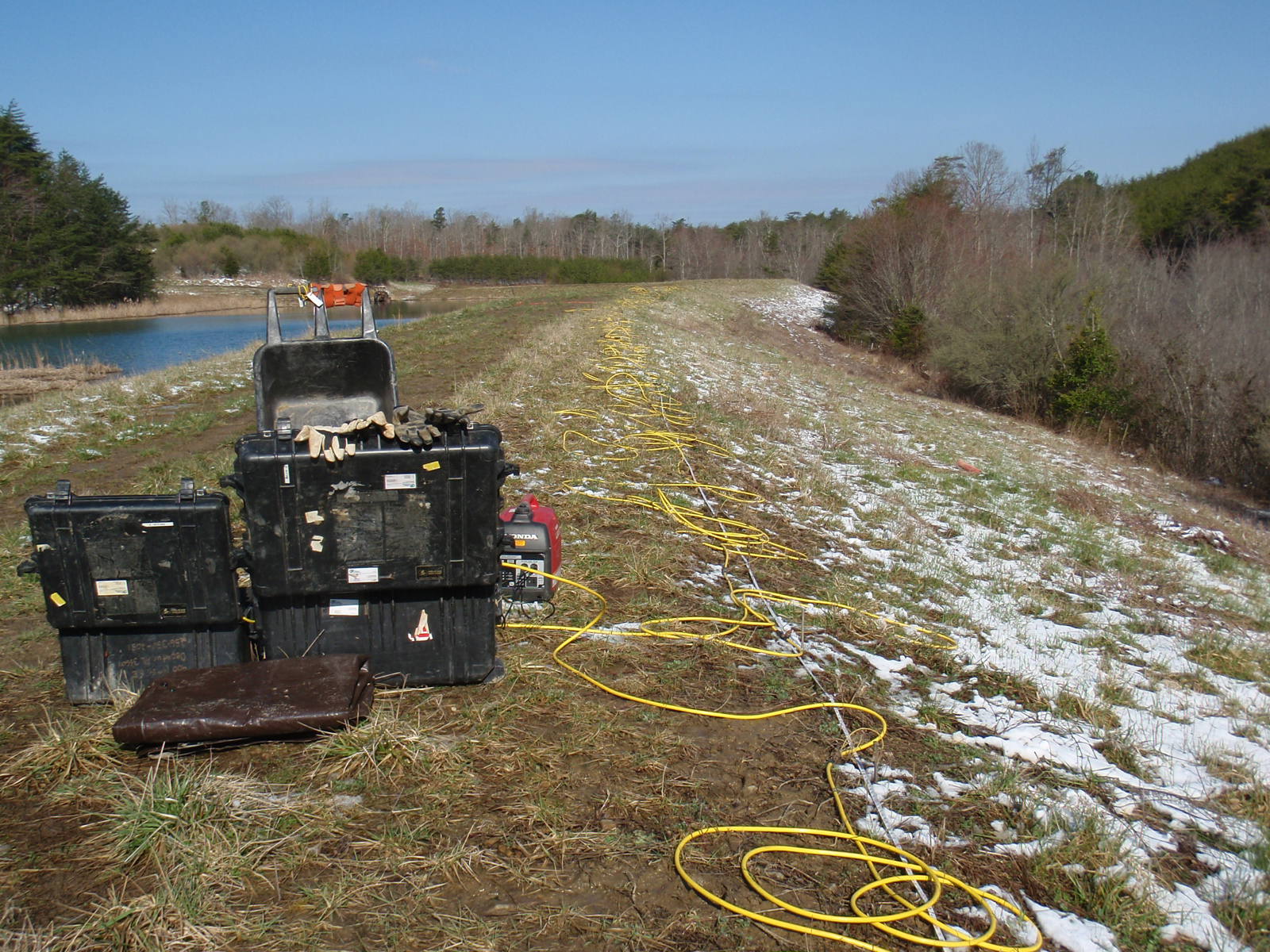
| Some of the resistivity equipment used by WyCEHG. |
“With resistivity, we’re mapping at how easy or hard it is
for electric current to flow in the materials below us.” Dr. Carr says.
Ground Penetrating Radar (GPR) is an electromagnetic method
that gives us very detailed images of the sub-surface, ice or snow pack
thickness.
GPR yields high detail images in the upper sub-surface. These
images are ideal for understanding what the sub-surface looks like at that
exact location, whereas resistivity and seismology are provide less detailed
information over a greater area. All of these instruments are useful for the
main levels of the subsurface, but WyCEHG is also going to look a little
deeper. To do this, FINSE will purchase a surface Nuclear Magnetic Resonance
(NMR) system.
“Really, what NMR is look for at is deeper (greater than
1000 feet) aquifer studies,” Dr. Carr says.
NMR is a useful tool for mapping regional watershed, which WyCEHG will
be doing throughout the next few years.
Part of keeping people interested in the center, is
introducing them to the tools. Already, FINSE equipment is being used in UW
classrooms, and this summer, it will be used extensively by researchers in the
fields and during WyCEHG’s two summer camps. This way, people from a variety of
backgrounds and disciplines are studying, understanding, and predicting the
amount of water in Wyoming for the future. And, water, especially from snow, is
everything in our high and dry environment.
By Kali S. McCrackin
Photo courtesy of Dr. Brad Carr
Friday, April 5, 2013
Field Day: Snow sampling and the coming of spring
Don’t sink. Don’t sink. Don’t…sunk.
We’re floundering around in waist deep snow,
our snowshoes buried and our packs throwing us off balance. The snow mixing
bucket and data clipboard in our hands add to the struggle of regaining our
footing, but we could not be more thrilled. The sky is blue, the sun is warm
and spring is on its way. The snow melting and soaking into our boots and
clothes makes that clear. One more week, and our outing would have been almost
pointless. Collecting snow samples with no snow would be impossible.
We scramble to our feet, the wet snow helping
us to slide down the slight slope to the road. We could not have asked for a
more perfect day.
| Wil Chapple mixes a snow sample. |
This field day is part of a WyCEHG project
focused on the isotope signatures of snow to help determine where snow melt is
actually going. Does the runoff end up in streams and watersheds, like Libby
Creek, where we are today, or is it stored in the ground and later used by
trees? This is one of the questions Dr. Dave Williams and EPSCoR Undergraduate
Fellow Wil Chapple are trying to answer. To do so, snow samples at specific
sites, picked because of their soil structure, must be methodically collected. Today,
our team of four heads to the Snowy Range Mountains, west of Laramie, to
measure and collect the snow Wil needs to continue work on his project and which
will be used to inform other aspects of WyCEHG’s work.
Water runs in little rivers down Barber Lake
Road where we pull off. The snow banks that usually cover the road until May
are melting in a hurry. Our collection sites are half a mile and a mile up the road. Elizabeth Traver (ET), manager of the Surface and Subsurface HydrologyLab (SSHL), and Wil accompany Dr. Williams and me to the first site, to show us
how to correctly measure the snow and collect the samples. We are using GPS
units and snow core samplers to pinpoint our locations and determine the snow
water equivalents (the depth of liquid water of the snow at a spot). The snow
core sampler is comprised of a scale with a hook and a long metal tube with
centimeters marked on the side and a sharp, slightly pointed end for digging
into the ground. In addition, we have a
clipboard with data sheets, plastic sampling bottles, a 100 meter measuring
tape, a stake, a bucket and a trowel.
| The snow core sampler. |
We start by poking the stake firmly into the
snow, attaching the measuring tape and walking it 50 meters across the top of
the slope we have decided to work on. This terrain was created from rock and
sediment deposited during the Bull Lake Glaciation period, approximately
140,000 years ago. Because of its age, this site has a different soil structure,
texture and chemistry than that on nearby hills which were created during the
much more recent Pinedale glacial event. Our goal at this site is to stay
within this soil type during our measurements, because Dr. Williams and Wil
believe that soil type affects water movement in this basin. In order to
understand this dynamic, all of our measurements must be within the same soil.
After Dr. Williams walks the tape measure out
50 meters, we measure the weight of the long metal tube: 0.71 kg. ET then
pushes the tube down vertically in the snow until it hits the ground below. We
take note of the snow depth: 42 centimeters. With gloved hands, so as not to
warm the tube, ET pushes down on it. This digs the sharp metal end of the tube
into the ground. When she pulls the tube out, there is no dirt in the bottom.
This means we didn’t hit the ground enough, so our measurements are not
accurate. We have to try it again.
This time the snow depth is 46 centimeters
and when ET pulls the tube out, deep brown dirt is clumped into the bottom. Perfect! We can take our next measurement, which is
the compressed depth snow: 22 centimeters. Carefully, ET digs the dirt out of
the bottom of the tube, trying not to scrape her fingers too much on the sharp
edges. Once all the dirt is out, we measure the weight again: 0.81 kg. This
final weight will allows us to calculate the snow water equivalent and snow
density. Every ten meters we will take these same measurements. At 0, 50, 100,
and 150 meters we will collect a snow sample for isotope analysis.
To do so, we dump the snow in the tube into
our mixing bucket and Wil stirs it around with the trowel. The snow we collect
in the tubes is from different storms, all with slightly different isotope
signatures. If we just scoop snow off the top of the bank, we only get a
signature for that layer of snow. So, to get a bulk isotope signature for that
exact spot, the layers must be mixed together. Once mixed, we stuff it into a
properly labeled plastic bottle.
With the method down, Dr. Williams and I head
10 meters down the line while ET and Wil slide their way back to the road to go
further up into the mountains to visit two other sites, one in Pinedale
glaciation terrain and one in pre-Pinedale glaciation terrain.
| A measurement site where one snow sample was taken |
By the end of the first 50 meters, we have a
system down. Dr. Williams take the measurements, I record the data, and we sink
through the snow to our next spot. At meter 50, we collect another sample, and
then it’s time to take measurements down slope. This time, Dr. Williams measures
100 meters down, making as straight of a line as possible. The aim is for our
measurements to be taken in an L shape, with 50 meters across the slope and 100
meters down the slope.
As we slip and slide down, our measurements
become more varied. Whereas the snow depth across the slope was similar at each
measurement point, down slope the snow depth ranged from almost 70 centimeters
to just 12. This snow was wet and in many places it had already collapsed
significantly before we took the measurements. Dr. Scott Miller, Co-Principle
Investigator for WyCEHG, told us this would be the case. There is more heterogeneity
down than across a hill.
At 100 meters down (and 150 meters total), we
are almost out of snow. Large patches of soil, covered with pine needles expose
the impact of the warm weather over the last few weeks. For some Laramie-ites,
tired of the winter, this may be a welcome sign of summer to come, but for
watershed and water resource managers this is an alarm bell going off. The
snowpack, according to the Water Resource Data System at UW, is at only 82% for
the entire state. With warm weather moving in already, this could be an ominous
sign for the coming summer. It is hard to tell if the snow melt from this
winter will be enough to keep wildfires at bay and water flowing down the
streams. This is why WyCEHG’s work is important. Without a complete
understanding of the water system, making accurate estimates about seasonal
conditions, water availability and water in general is difficult. With WyCEHG’s
data and research, water resource managers can be armed with the tools they
need for more accurate predictions about the seasons to come.
One site down, one site to go. Dr. Williams
and I head up the road to take measurements from a site formed during the
Pinedale glaciation event.
By Kali S. McCrackin
Photos by Kali S. McCrackin
Friday, March 29, 2013
On a mission to make a difference: Wyoming EPSCoR’s Project Coordinator
Earlier this year we started a series of blogs about the EPSCoR office. The follow is part four of the series and focuses on Project Coordinator Rick Matlock.
Raging snow storms and a rural setting were not exactly Rick
Matlock’s idea of a great college experience. Rick, who today is the Project
Administrator at Wyoming EPSCoR, could not wait to leave Laramie and its
winters behind.
![]() |
| Rick Matlock has been with Wyoming EPSCoR since 2002. |
“When I first moved here, I lived in the dorms,” Rick said.
“I moved up here from New Mexico and the blizzards were just enormous the first
couple of years. I just despised it. And, it was a small town, with absolutely
nothing to do. I just despised that too.” Rick laughs at this now and adds,
“But the way to live in Laramie is to accept your surroundings and to be part
of the outdoor scene.”
And that is exactly what Rick has done. While today he
enjoys snowboarding, snowshoeing, hiking and fishing in the surrounding
mountains, those activities were not what brought him to the University of
Wyoming. He came instead to pursue a degree in psychology, in order to reach
his goal to help people.
“When I first got out of high school, I wanted to be a helping-people-person,”
Rick says. “I wanted to help the seriously mentally ill and depressed.”
After finishing his degree, Rick worked in the medical field
in a variety of areas including an inpatient psychiatric unit, a home for at
risk youth and the local crisis center. While these experiences were rewarding,
each in their own way, they also took their toll on him and after almost twelve
years, Rick found himself burnt out.
“I kind of found out that this wasn’t really my calling,”
Rick says. “So, I decided to try to put my psychology degree to use somewhere
else.”
He came to UW and worked at the graduate school
administrative office wanting to start into academic advising.
“I enjoyed that experience,” Rick says. “But then the job
opened up to run the undergraduate program here at EPSCoR and I decided to take
it.”
Rick is in charge of EPSCoR programs, such as our
Undergraduate Research Fellowships and Undergraduate research day, which
support students going into the science fields, but he makes sure things run
smoothly for our grant projects.
“What I do now is, I administer or organize the various
aspects of the EPSCoR goals,” Rick says. “It is making sure that everything is
staying on track, making sure the EOD (education, outreach and diversity)
components are coming together, and making sure we stay on track with the
budget.”
While he is no longer helping people in the way he
originally set out to do, he is helping to make a difference in the lives of
future scientists through his work with our undergraduate programs. This work is
inspiring for several reasons.
“The most rewarding part is working with a diverse group of
people,” Rick says. “I am able to work with scientists I wouldn’t ever normally
meet and I get to work with a lot of great students through undergraduate
research. I am amazed by all the different things the students are doing.”
As a student in college, Rick couldn’t imagine ever saying
this, but today he loves living in Laramie. “It’s got the best of everything,
essentially.”
By Kali S. McCrackin
Photo by Leah Yetter
Thursday, March 14, 2013
SRAP Alumna Courtney Gettel: Snail tails, writing skills and college life
![]() |
| Courtney collecting samples this summer |
“It was a great experience,”
Courtney says. “I learned quite a bit. It was a good introduction to
more-complicated-than-high-school stuff.”
Leaving home for the first time
to go to college can be difficult, especially for family people. It was one
thing Courtney was worried about as high school came to an end. Her transition
from high school to UW however, was eased by her participation in SRAP.
“My family and I feel that SRAP
was helpful in the transition to college because living away from home for
those six weeks was a good amount of time to get used to it and to get used to
the freedoms, but having the responsibilities,” Courtney says. “It made coming
to college a lot easier.”
By the time SRAP ended, Courtney
was ready to return home to Denver, but was looking forward to coming back for
the start of fall semester. Along with her first taste of living on her own and
getting through homesickness, Courtney’s love of science was solidified through
her project.
Courtney worked in Dr. Amy
Krist’s lab alongside graduate student Brenda Hansen. The focus of their
project overall was determining if snails have a preference for food with
better nutrients.
“My project itself was looking at
the differences of nutrition within plants in different parts of a river,”
Courtney says. “Specifically, we were looking at phosphorus levels in plants.”
Part of the work involved writing
a research paper. For Courtney, this was both frustrating and a great learning experience.
“It was frustrating at times
because I kept getting back these papers that just had ink all over them,”
Courtney says. “But then I learned quite a bit, and actually it bettered my
writing for coming into college.”
Hansen’s tough grading, while wearisome
at first, has served Courtney well in college.
“I don’t know if it was
specifically Brenda, but my writing was definitely much more prepared for
college and I’m seeing that in my labs,” Courtney says. “Some people are having
trouble figuring out the labs, but I feel like I have an advantage from working
with Brenda, and her expecting me to write an almost paper ready edition of my
project.”
![]() |
| Courtney at the Laramie River this summer. |
“Our weekend programs were really
fun,” she says. “We got to see a play and do a ropes course at Colorado State
University. That was all really fun. Even the working part was pretty fun. I
liked getting to work in the lab because that’s hopefully where I’ll be when I
graduate.”
Although graduation is still a
few years down the road, Courtney is interested in going to graduate school for
Marine Biology or to veterinary school. For now, however, she is getting the
hang of studying and time management, while enjoying the college life.
“College has been wonderful,”
Courtney says. “I really have enjoyed it.”
To learn more about SRAP, please visit: http://www.uwyo.edu/epscor/fellowships-and-student-programs/srap/index.html. Applications for the Summer 2013 program
are due March 15th, 2013. By Kali S. McCrackin
Photos courtesy of Dr. Amy Krist
Subscribe to:
Posts (Atom)